The case for MMTP + MoQ: three lab results on multicast loss
By Omar Ramadan · November 24, 2026
On multicast, nothing resends a lost packet. Here is what kept the picture moving in our lab, with one live H.264 stream:
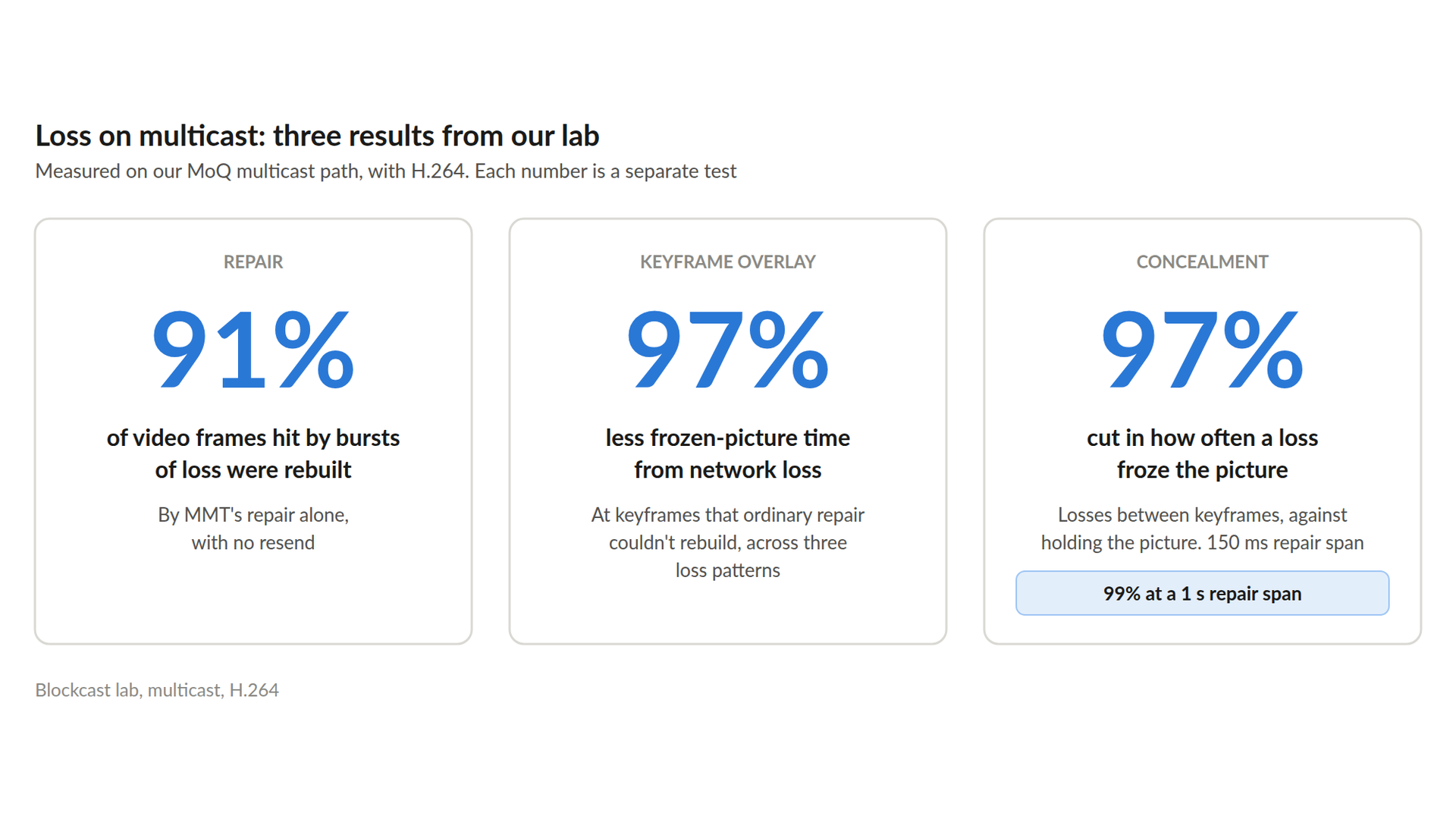
Repair: 91%. MMT's repair alone rebuilt 91% of the video frames hit by bursts of loss.
Keyframe overlay: 97%. A second repair stream covers keyframes. It cut frozen-picture time from network loss by 97%. That's at keyframes that ordinary repair couldn't rebuild, across three loss patterns.
Concealment: 97%. When repair misses a frame between keyframes, the player drops that frame and keeps decoding. That cut how often such a loss froze the picture by 97%, against holding the picture until the next keyframe, at a 150 ms repair span. At a 1 s repair span, the cut was 99%.
How the player knows what it lost
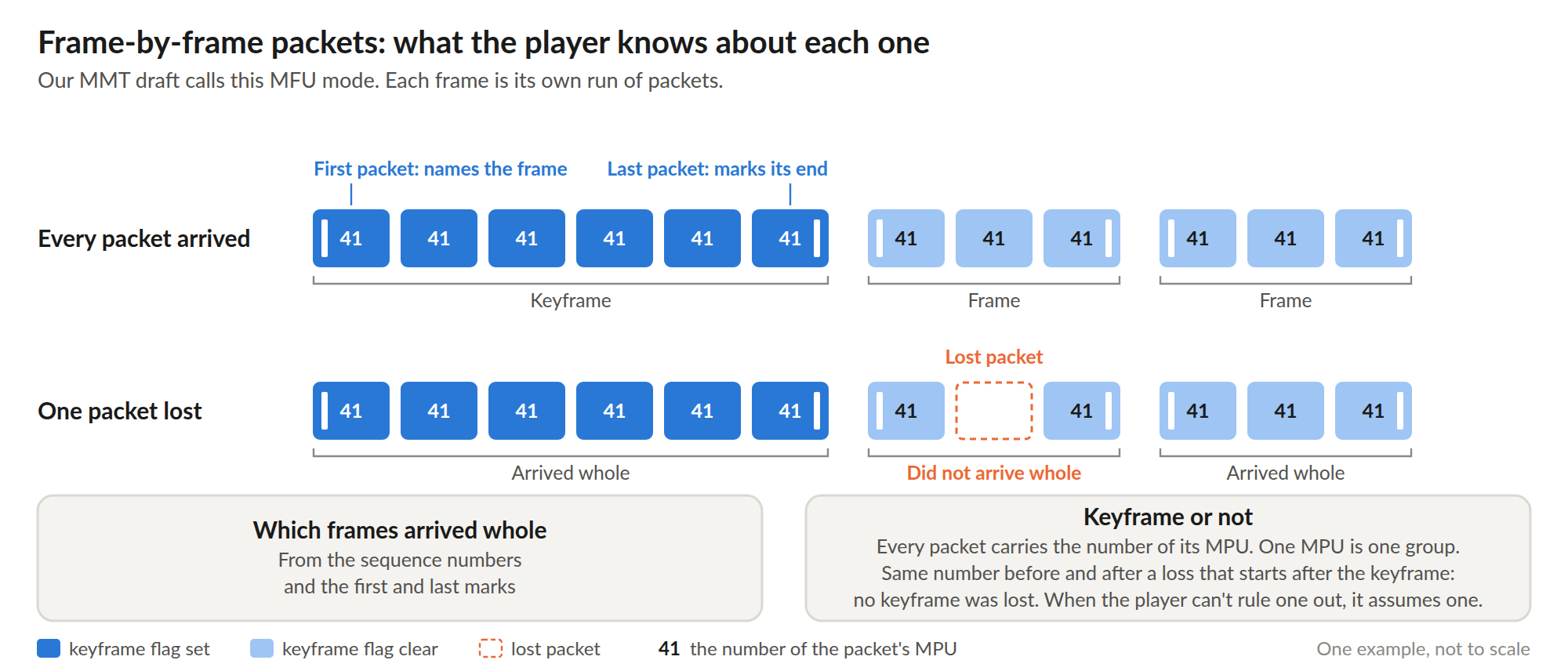
Our encoder sends each frame as its own run of MMTP packets. The first packet names the frame, and the last marks its end. Every packet carries the number of its group of frames, so the player can tell a lost keyframe from a lost in-between frame.
Figure 1. Frame-by-frame packets, which our MMT draft calls MFU mode: what the player knows about each packet.
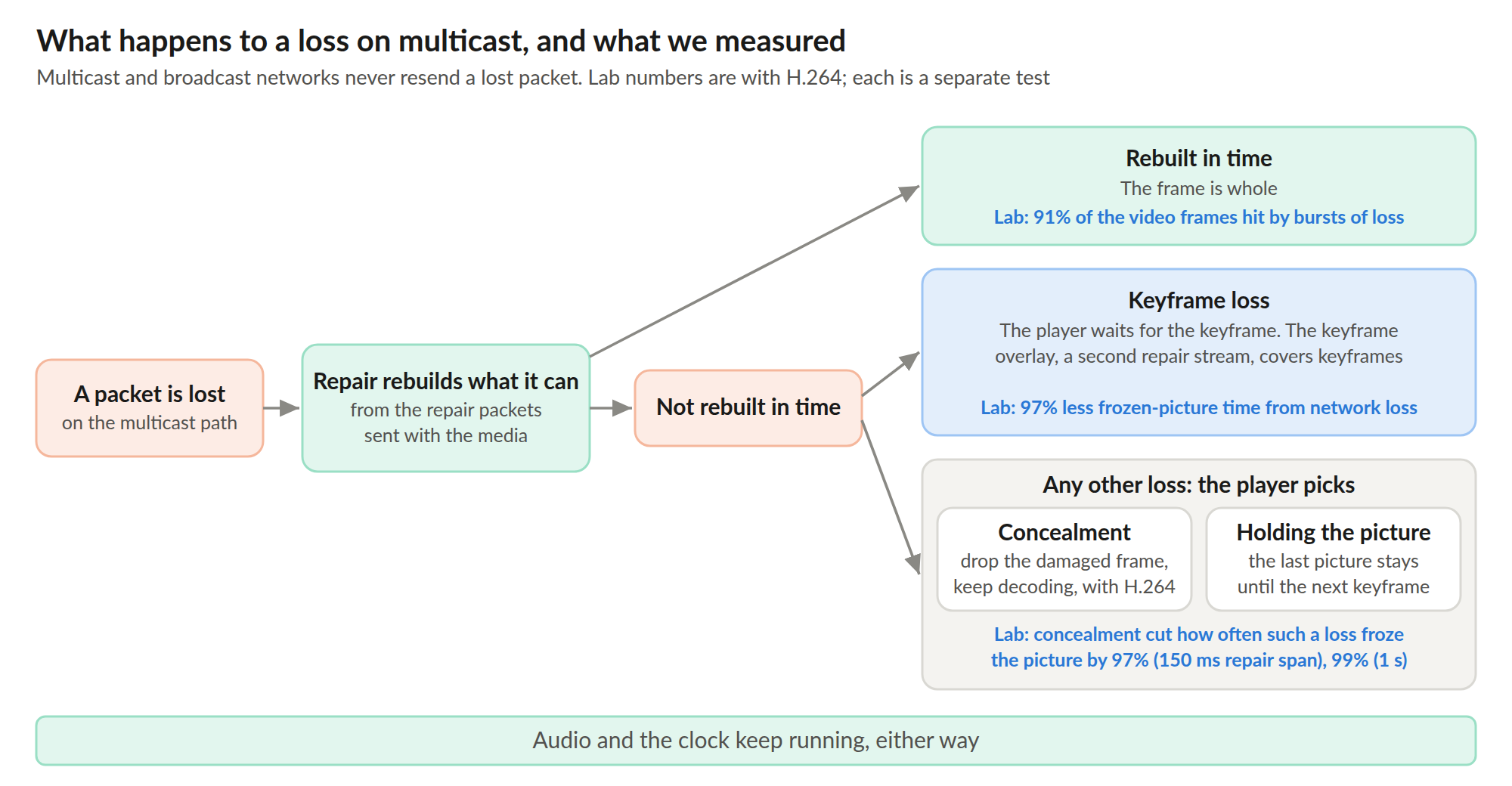
So the player waits only when a keyframe may be missing. At any other loss it keeps decoding. Audio and the clock keep running either way.
Figure 2. What happens to a loss on multicast, and what we measured. Lab numbers are with H.264; each is a separate test.
What the results cover
One stream, one kind of loss. A live 720p H.264 test stream with a keyframe every second, on our lab's MoQ multicast path. Bursts of about a third of a second, in three patterns.
Three separate tests. Each number comes from its own test in our lab.
How often, not how long. For concealment we counted how many losses froze the picture. The frames after a lost one can show artifacts until the next keyframe.
Two choices of our own player. Not MMTP against LOC or CMAF, two other MoQ formats.
Read the drafts
draft-ramadan-moq-mmt: MMT inside MoQ, including frame-by-frame packets and the keyframe overlay.
Live Demo: our web player plays our live ISS stream, MMTP over MoQ, in an unmodified Chromium-based browser.
The same packets carry other codecs too: H.264, H.265, VP9 and AV1 all play over MMTP in our lab, in two players.
In a separate test with two-layer, error-resilient VP9, keeping on decoding cut how often a loss froze the picture by 98% (at least 91% at 95% confidence), against holding the picture. That was one live stream on multicast in our lab, in stock Google Chrome, with about one packet in 5,000 lost at random and no repair.
If you build players, I'd like to hear what your decoder does with a lost frame.